A Rescue Diver course in Cozumel changes the way you see every buddy team, boat briefing, and current line. You are no longer focused only on your own buoyancy, air, and camera angle. You begin to notice the diver who looks uncomfortable, the buddy pair that has drifted apart, or the small problem that is easier to solve before it becomes a real emergency.
For many certified divers, Rescue is the course where confidence stops feeling borrowed from an instructor and starts becoming their own. It is challenging, active, and deeply rewarding. Set against Cozumel’s clear water, warm conditions, and famous drift diving, it is also an outstanding place to build skills you will carry on every dive trip that follows.
What You Really Learn in a Rescue Diver Course in Cozumel
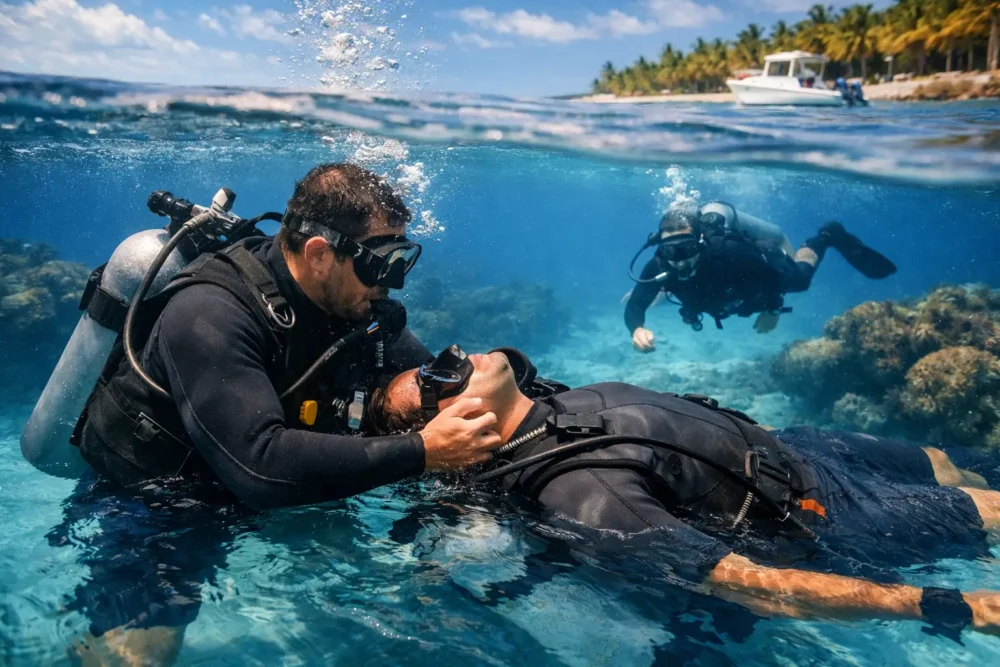
The Rescue Diver course is not about expecting disaster on every dive. It is about becoming a calmer, more capable diver when something does not go as planned. You will learn to recognize stress early, assist a tired or panicked diver, manage emergency scenarios at the surface, search for a missing diver, and respond to an unresponsive diver in and out of the water.
That sounds serious because it is. But the best rescue training is not built on fear. It is built on repetition, judgment, teamwork, and clear communication. You practice the same fundamentals until your response becomes more organized under pressure. By the end of the course, many divers say they feel more relaxed underwater because they understand what to do if a problem develops.
The course also makes you a better buddy. You will sharpen your pre-dive checks, learn to spot signs of anxiety and overexertion, and get more intentional about planning. Those habits matter whether you are making an easy Caribbean reef dive or preparing for a more demanding trip later on.
Why Cozumel Is a Smart Place to Train
Cozumel offers conditions that let students focus on skill development rather than battling cold water or low visibility. Warm Caribbean water and generally clear conditions make it easier to see your instructor, communicate with your team, and stay engaged through longer practical sessions.
The island is also known for drift diving. Currents can be gentle or more energetic depending on the day and reef, which gives students a valuable reason to practice strong planning and awareness. Drift diving is beautiful and effortless when the group is organized, but it also reinforces why staying with your buddy, monitoring the group, and following a clear surface procedure matter.
Still, Cozumel is not a shortcut. Clear water does not make rescue skills automatic, and current adds a real-world variable. A professional instructor should adjust the training plan to the conditions, choose appropriate sites, and make sure each student has time to understand the why behind every exercise. If weather or current is not right for a particular skill, changing the plan is good judgment, not a compromise.
Who Should Take Rescue Next?
Rescue is a natural next step for divers who have moved beyond the basics and want more responsibility in the water. You do not need to be the most experienced diver on the boat. In fact, the course is especially valuable for divers who want to replace occasional uncertainty with practical preparation.
Before starting, you generally need an Advanced Open Water Diver certification or a qualifying certification, plus current emergency first response training in CPR and first aid. PADI requires Emergency First Response Primary and Secondary Care training, or an equivalent qualifying course, completed within the previous 24 months. If your CPR and first aid training has expired, it can usually be refreshed before or alongside your Rescue training.
This is also a strong course for divers considering Divemaster someday. Rescue teaches the awareness and problem-solving mindset expected of dive professionals. But you do not need professional ambitions to benefit. Plenty of recreational divers take Rescue simply because they want to be the buddy others are glad to have.
What the Training Feels Like
Expect a mix of knowledge development, confined-water skill practice, and open-water scenarios. The academic portion covers diver stress, accident management, emergency equipment, response planning, and the decisions behind effective rescues. The practical portion is where everything starts to connect.
You may practice approaching and assisting a distressed diver, towing a tired diver, responding to simulated panic, removing equipment at the surface, and managing an unresponsive diver. Later, you put skills together in scenarios that require you to assess what is happening, assign tasks, communicate clearly, and act without waiting for someone to tell you every next move.
Some exercises can feel physically demanding. Towing a diver, maintaining control at the surface, and staying focused while coordinating a response require effort. That is part of the point. Rescue training should stretch you, but it should never leave you feeling unsupported or embarrassed for needing another try.
A small student group makes a meaningful difference here. You get more repetitions, more direct feedback, and more room to ask questions. Instead of being processed through a crowded class, you have the space to understand each skill and improve it. At Blue Magic Scuba, personal instruction and small-group diving are central to the experience, because confidence grows faster when your instructor actually knows how you learn.
The Difference Between Passing and Feeling Prepared
Technically, every certification has performance requirements. But a card alone is not the goal. The goal is leaving Cozumel able to think clearly when another diver is stressed, tired, separated from the group, or in need of help.
Look for an instructor who explains the context behind the skills. Why approach a distressed diver with caution? Why establish buoyancy before attempting another task? Why delegate to available buddies rather than trying to do everything yourself? These decisions are what turn individual drills into practical rescue thinking.
It also helps to train with a team that takes boat operations seriously. Licensed boats, experienced crew, oxygen availability, communication procedures, and thoughtful site selection are not background details. They show students what disciplined diving looks like before anyone enters the water.
How to Prepare Before You Arrive
The best preparation is simple: arrive rested, comfortable with your basic scuba skills, and ready to participate fully. Rescue is easier to enjoy when mask clearing, regulator recovery, buoyancy control, and basic navigation do not consume all of your attention.
Review your certification records and confirm your CPR and first aid status before booking. Bring any medical documentation required for diving, and be honest about your comfort level in the water. Nervousness is not a reason to avoid Rescue, but it is useful information for your instructor. A good training plan meets you where you are and helps you progress safely.
If you are planning a vacation around the course, give yourself enough time. Rushing from travel day to training day can make an already active course feel harder than it needs to. Cozumel is better when you leave room to sleep well, enjoy the island, and spend time on the reefs without watching the clock.
Rescue Training Carries Into Every Future Dive
After Rescue, the reef often looks the same, but your awareness changes. You notice exit points before you need them. You listen more closely during briefings. You check on your buddy with purpose, not just habit. You become more useful on the boat and more dependable in the water.
That is the real value of choosing a Rescue Diver course in Cozumel. You earn a respected certification in one of the Caribbean’s great dive destinations, then take home a steadier mindset that belongs on every dive. Give yourself the time to train well, ask every question, and become the calm buddy you would want beside you when conditions get interesting.