
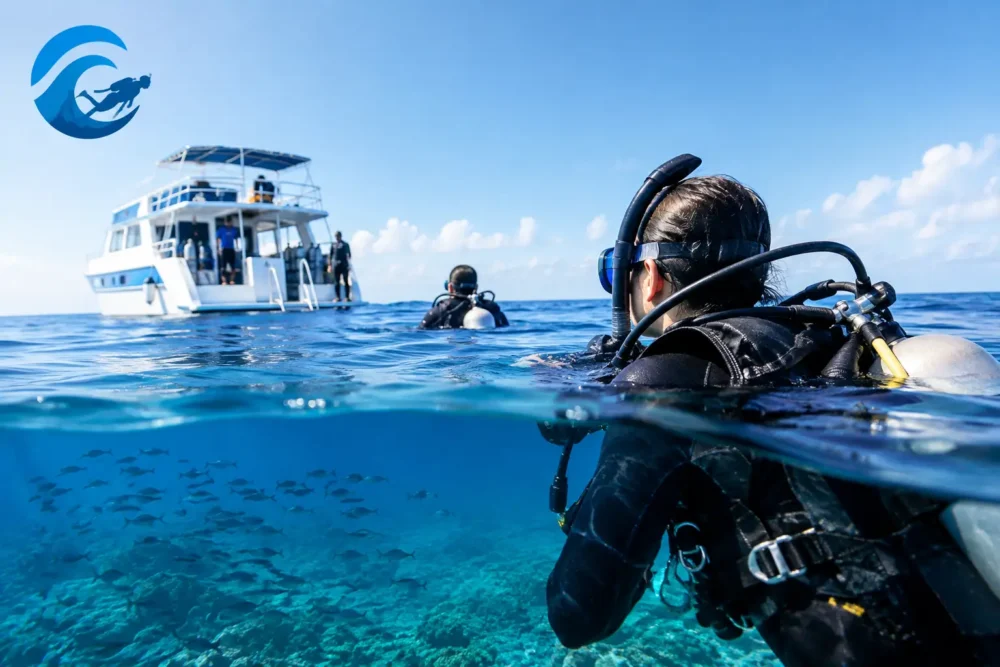
A great drift dive feels almost effortless: you descend, settle into your buoyancy, and let the reef come to you. But that relaxed feeling is earned before anyone steps off the boat. Knowing how to plan drift dives means understanding the current, agreeing on a simple team plan, and having a boat crew that knows exactly where to find you when the dive ends.
Cozumel is famous for current-driven reef diving, from gentle cruises along colorful walls to faster-moving conditions that demand sharper awareness. The payoff is extraordinary terrain, less kicking, and more time watching turtles, eagle rays, schools of fish, and healthy Caribbean coral. The responsibility is to plan for the conditions you have, not the conditions you hoped for.
Start With the Right Drift-Dive Mindset
A drift dive is not simply a regular reef dive where everyone happens to move. The current changes navigation, separation risk, gas planning, ascents, and surface procedures. Your group should expect to begin and end in different locations, potentially far apart.
That does not make drift diving intimidating. It makes clear communication valuable. Before the dive, every diver should know the entry method, maximum depth, expected current direction, turn pressure, ascent plan, and what to do if separated from a buddy or the group. If any part of that plan feels unclear, ask before gearing up. A good briefing welcomes questions.
Conditions can also vary dramatically along one coastline. A site that normally offers an easy glide may have stronger current after weather changes, tidal shifts, or wind. The best plan is flexible enough to choose a protected reef, adjust the route, or call off the dive if conditions exceed the team’s experience.
How to Plan Drift Dives Around Current and Weather
Current is the defining feature of a drift dive, but it is not always uniform. It can strengthen near a point, soften in a sandy channel, reverse close to a wall, or move differently at depth than it does on the surface. Local knowledge matters because a captain and guide who dive the area every day can read those patterns better than a forecast alone.
Ask about the likely current before the boat leaves, then listen again at the site. The crew may check the water by observing surface movement, deploying a current line, or watching how the boat tracks. This final assessment should guide the actual plan.
For recreational divers, the most comfortable conditions are often a steady, manageable current with good visibility and a clear pickup area. Strong current is not automatically a better dive. It can be exciting for experienced divers, but it reduces the margin for slow descents, photography stops, and correcting buoyancy problems. Newer divers should say so honestly. Choosing an easier site is good judgment, not a missed opportunity.
Weather deserves equal attention. Wind can create chop at the surface even when the underwater current is mild. Rain may not affect visibility much in offshore water, while a change in wind direction can make the boat ride and exit more demanding. Your crew should make the call based on real conditions, not a fixed schedule.
Build a Plan the Whole Team Can Repeat
The best drift-dive plans are simple enough that every buddy pair can repeat them back. Start with the descent. In many current conditions, divers enter promptly, meet at an agreed depth, and descend without lingering on the surface. Taking too long to organize after entry can spread the group out before the dive has begun.
Next, establish positioning. Stay close to your buddy and within the guide’s visual range, but avoid crowding the reef or swimming directly over another diver. In a current, a loose line of divers usually works better than a cluster. Everyone should be able to see the guide, their buddy, and the blue water beyond the reef.
Agree on depth and gas limits before the descent. A common mistake is treating the current as a reason to drift deeper than planned. It is still your dive profile. Respect the maximum depth, monitor your computer, and begin a gradual move shallower as the dive progresses when appropriate for the site.
For gas planning, use a conservative turnaround pressure that leaves enough air for a calm ascent, a safety stop, and an unexpected delay. In a drift dive, you may not be able to swim back to the boat, so the plan must assume you will finish wherever the current takes you. Divers with higher air consumption should be paired thoughtfully and should tell the guide early rather than trying to keep up silently.
Use the right surface-signal equipment
Every drift diver should carry a delayed surface marker buoy and know how to deploy it. A whistle or other audible signaling device is also useful, and a signal mirror can help in bright Caribbean conditions. Your guide may send up a marker at the safety stop, but each buddy team should be prepared to signal independently if separated.
Check that your DSMB is properly secured and that the spool or reel runs freely. Practice deployment in calm, supervised conditions before relying on it in current. A tangled line, an uncontrolled ascent, or a buoy launched directly under another diver is a preventable problem.
Plan the Entry, Ascent, and Pickup
Drift dives are often boat dives, and boat procedures are part of the safety plan. The captain needs to know the group’s entry order, the guide needs divers ready to go, and everyone should understand the signal for entering. Keep masks on, regulators in, and fins ready before you approach the exit point. Once the call is made, enter with purpose and clear the area quickly.
Your ascent should be just as organized. Near the end of the dive, the guide may send up a DSMB and lead the group into a safety stop in blue water or near a shallow reef section. Maintain neutral buoyancy and stay aware of your buddy. Do not assume the boat is directly overhead when you surface.
Once on the surface, inflate your BCD if needed, keep your mask and regulator in place until you are settled, and look for the boat. Stay together as a buddy team. If you are separated from the group, deploy your DSMB, make yourself visible, and follow the lost-diver procedure discussed in the briefing. Avoid long surface swims against current unless the crew specifically directs you to do so.
A professional drift-dive operation tracks the group from the boat, anticipates where divers will surface, and picks them up in a controlled sequence. That support matters, especially when conditions are moving faster than expected. At Blue Magic Scuba, small boat groups help guides keep a closer eye on each diver while fast boats make reef access and pickup more efficient.
Adjust Your Equipment for a Better Drift Dive
Good trim and buoyancy are more than comfort skills in a current. They help you hold position near the reef without finning hard, protect coral from accidental contact, and make stops easier. Streamline hoses, secure gauges and accessories, and avoid anything dangling that could snag or drag.
Choose fins you can control comfortably. Very stiff fins may be useful for some divers in stronger water movement, but technique and fitness matter more than owning the most powerful pair. A calm, efficient kick saves gas and keeps the group’s pace relaxed.
A reef hook may be used at certain destinations and only where local rules and environmental practices allow it. It is not a universal drift-diving tool and should never be attached to living coral. In Cozumel, the better approach is usually buoyancy control, respectful distance from the reef, and following your guide’s local procedures.
Know When to Skip or Change the Dive
The most experienced divers are not the people who always enter the water. They are the people who recognize when the plan no longer fits the conditions. If you are anxious, underweighted or overweighted, tired, fighting an ear issue, low on confidence, or uncomfortable with the current described in the briefing, tell the guide.
There is usually another option: a shallower site, a calmer afternoon dive, a refresher in buoyancy skills, or a Drift Diver specialty session that lets you build competence with an instructor. The goal is not to prove that you can handle any current. The goal is to make every dive safe enough to enjoy.
On your next Cozumel morning, take the briefing seriously, keep your plan simple, and trust the crew’s local knowledge. Then let the current do what it does best: carry you past a reef you would never experience the same way by swimming against it.