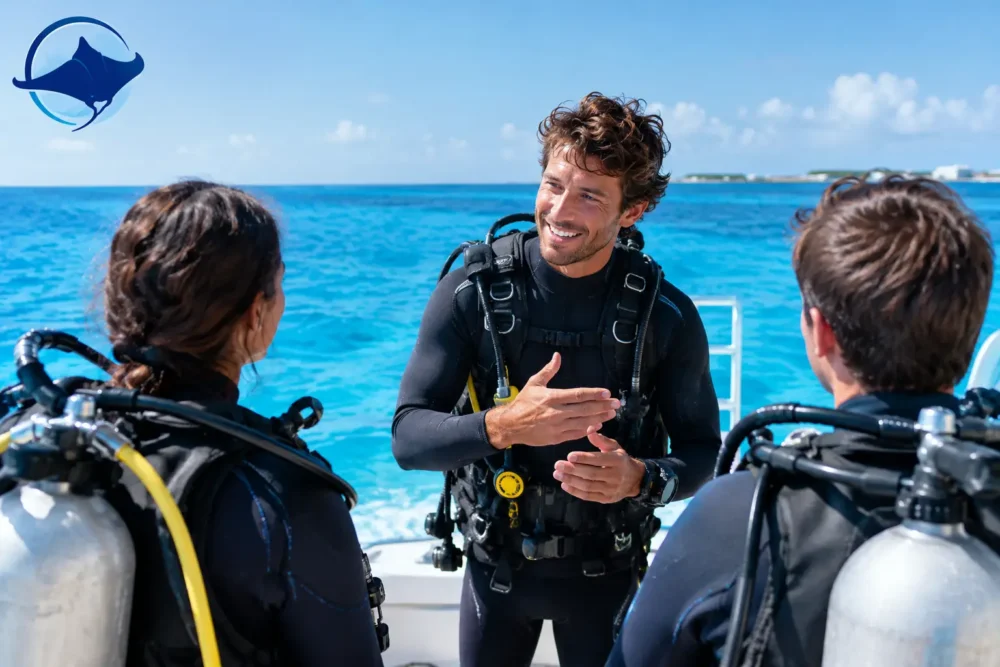
The moment you teach a nervous new diver to breathe calmly underwater, you understand that becoming an instructor is about far more than earning another certification. If you are asking how to become a dive instructor, you are considering a professional path built on leadership, patience, sharp judgment, and a genuine love for helping people experience the ocean safely.
Cozumel is an exceptional place to begin that journey. Warm Caribbean water, clear visibility, healthy reefs, and daily drift diving give aspiring professionals the repetition and real-world perspective that a classroom alone cannot provide. The goal is not simply to pass an exam. It is to become the instructor divers remember because you made them feel capable, prepared, and welcome.
How to Become a Dive Instructor: The PADI Path
The standard path to becoming a PADI Open Water Scuba Instructor is progressive for a reason. Every level gives you skills you will later need to demonstrate, explain, supervise, and evaluate in others.
You begin as an Open Water Diver, then continue through Advanced Open Water and Rescue Diver. Along the way, specialty training such as Enriched Air Nitrox, Deep Diver, Drift Diver, or Sidemount can make you a more versatile diver and improve your understanding of the environments where you may eventually teach.
Before entering professional training, you need Emergency First Response Primary and Secondary Care training, or an equivalent current first-aid and CPR credential. You will also need a medical statement signed by a physician within the previous 12 months. These are not paperwork hurdles. Instructors are responsible for recognizing stress, preventing small issues from becoming serious, and responding decisively when help is needed.
The next major step is becoming a Divemaster. After that, you complete an Instructor Development Course, commonly called an IDC, and pass the Instructor Examination, or IE. Once certified, you can teach PADI courses within the limits of your instructor rating.
The experience requirements
PADI sets minimum experience requirements at each stage. To begin Divemaster training, you need to be at least 18 years old, hold Rescue Diver certification, have current first-aid and CPR training, and log at least 40 dives. You must have 60 logged dives to earn the Divemaster certification.
To attend an IDC, you need to be a certified diver for at least six months, be a PADI Divemaster or qualifying leadership-level diver from another organization, and have at least 60 logged dives. You need 100 logged dives before attending the Instructor Examination.
Those numbers are minimums, not a finish line. A diver with 100 thoughtful dives across varied conditions usually arrives with much stronger judgment than someone who rushed to collect 100 easy dives. Drift conditions, changing currents, boat entries, navigation challenges, and assisting real students all add useful experience.
Build Your Foundation Before Going Pro
Great instructors make difficult skills look calm and simple. That confidence is earned through repetition, not bravado.
During your recreational courses, focus on buoyancy, trim, situational awareness, and communication. Practice hovering without touching the reef. Learn to maintain position in a current without exhausting yourself. Get comfortable deploying a surface marker buoy, helping a buddy, navigating, and managing your own equipment without needing a crew member to solve every small problem.
Rescue Diver training is a turning point for many people. It shifts your attention outward. Instead of thinking only about your own air supply and depth, you learn to notice a buddy who is cold, overexerted, distracted, or uncomfortable. That awareness becomes essential when you are supervising students with different confidence levels.
It also helps to gain experience outside your comfort zone. Cozumel’s famous drift diving is fantastic, but a future instructor should also understand shore diving, low-visibility conditions, surface skills, and different entry methods when possible. You do not need to be fearless in every environment. You do need the humility to recognize your limits and the discipline to keep learning.
Divemaster Is Where the Work Gets Real
Divemaster is not merely a box to check before instructor training. It is where you learn how a dive operation actually runs.
A quality Divemaster program should put you close to daily boat operations, equipment handling, guest briefings, diver check-ins, site planning, customer service, and supervision. You may assist courses, guide certified divers, refresh rusty skills, help prepare gear, and learn why a clear briefing can transform a good dive day into a great one.
This practical exposure matters because professional diving includes plenty of work that happens above water. An instructor needs to organize students, manage time, read sea conditions, set expectations, care for equipment, coordinate with crew, and create a relaxed atmosphere without letting standards slide.
An internship can be especially valuable for aspiring professionals who want more than certification cards. At Blue Magic Scuba, professional candidates can train around real dive-shop and boat operations, gaining the kind of hands-on experience that makes the transition from student to working dive professional feel much more natural.
Choose mentorship, not just a calendar
Divemaster programs vary widely. Some are fast and academic, while others allow time for mentorship and operational experience. The right choice depends on your background, timeline, budget, and career plans.
If you already have extensive experience and strong skills, an intensive route may suit you. If you are new to professional diving, a longer internship can offer better value because you have more time to assist actual students, refine demonstrations, and receive feedback from several instructors.
Ask how often you will be in the water, whether you will assist real courses, who will mentor you, and what daily responsibilities are included. Also ask about accommodation, equipment costs, materials, and fees for the Instructor Examination. A low advertised price can become expensive if essential costs appear later.
What Happens During an Instructor Development Course?
The IDC prepares Divemasters to teach, not just to know the material. You will review dive theory, workshop knowledge-development presentations, practice confined-water teaching, and conduct open-water teaching scenarios. You will also learn PADI standards, risk management, course organization, and how to assess student performance fairly.
Expect to practice the same skills repeatedly. You will need to demonstrate them slowly, clearly, and with excellent control while explaining what students should do, what common problems look like, and how to coach corrections without overwhelming anyone.
Many talented divers find this humbling at first. Being able to perform a mask-clear is different from teaching it to a person who is anxious about water in their face. The best instructor candidates accept feedback, practice with purpose, and improve quickly.
An IDC also includes the Emergency First Response Instructor course for candidates who need that rating. This lets you teach CPR and first aid courses, which are required components for many divers advancing toward Rescue Diver and professional-level training.
Passing the IE and Starting Your Career
The Instructor Examination is an independent evaluation of your teaching ability, dive knowledge, skill demonstration, and standards awareness. It is designed to confirm that you can teach safely and consistently, not to catch you out with tricks.
Preparation is the advantage. Arrive with your dive theory current, your skill demonstrations polished, and your materials organized. Practice speaking clearly under pressure. More importantly, learn to reset after a mistake. In real teaching, composure matters as much as perfection.
After you pass, your first goal should be experience, not speed. Teach alongside experienced professionals when you can. Start with courses you know well, ask for feedback, and continue adding specialties that fit your destination and the divers you want to serve. In Cozumel, Nitrox, Drift, Deep, and Sidemount specialties can be especially relevant.
You may eventually pursue Master Scuba Diver Trainer status, IDC Staff Instructor, specialty instructor ratings, or even the path toward Course Director. But a respected career is built one well-taught student at a time.
Is Becoming a Dive Instructor Right for You?
The lifestyle is rewarding, but it is not a permanent vacation. Early mornings, hauling gear, weather changes, administrative tasks, long teaching days, and the responsibility of other people’s safety are all part of the job. Income can also vary by season and location, particularly early in a career.
The upside is meaningful work in extraordinary places. You help travelers move past fear, celebrate first breaths underwater, and develop skills that change how they see the ocean. You also become part of a global professional community connected by high standards and a shared respect for the underwater world.
If that responsibility excites you more than the idea of simply logging dives, take the next step with a program that gives you personal coaching, real operational experience, and enough water time to grow into the role. The reefs will always be there. Your chance to become the calm, capable instructor someone trusts with their first breath underwater is worth preparing for properly.