
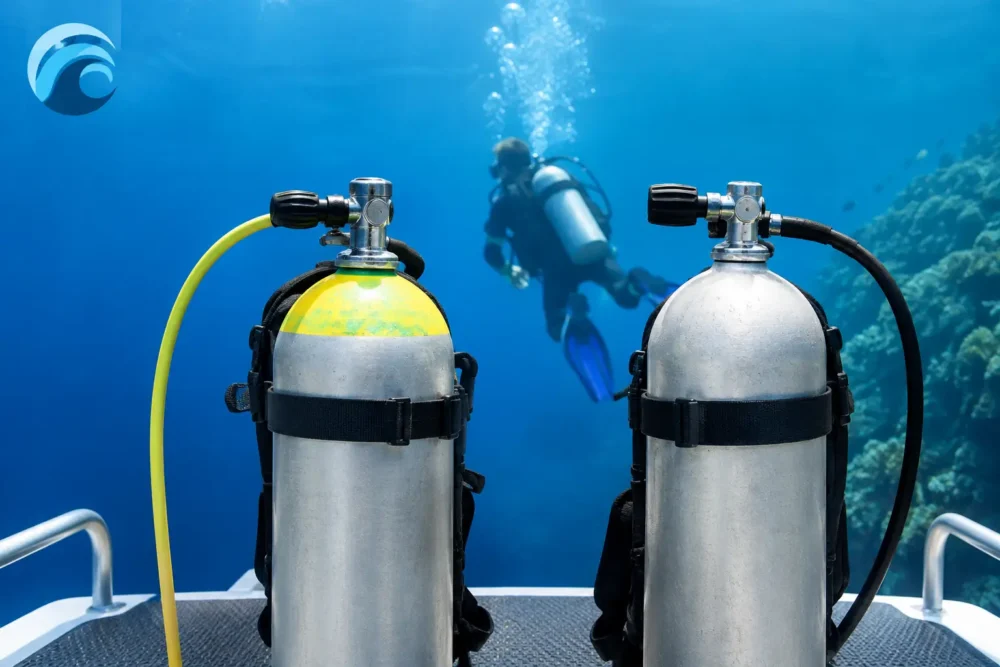
The choice of Nitrox versus air often comes up on the dock just before a beautiful Cozumel two-tank morning. One diver wants longer no-decompression limits on a second reef dive. Another is headed deeper and wonders whether Nitrox is even useful. Both questions deserve a real answer, not a sales pitch: the right gas depends on your depth, profile, training, and how you feel after several days in the water.
For many Caribbean divers, enriched air Nitrox is a smart tool. It is not a better gas for every dive, and it does not make the rules disappear. Used correctly, however, it can make repetitive reef diving more flexible and comfortable.
What Is the Difference Between Nitrox and Air?
Regular compressed air is made up of roughly 21 percent oxygen and 79 percent nitrogen. Enriched air Nitrox contains more oxygen and, therefore, less nitrogen. The most common recreational blends are 32 percent oxygen, often called EAN32, and 36 percent oxygen, or EAN36.
That reduced nitrogen is the key. During a dive, your body absorbs nitrogen under pressure. The deeper and longer you stay down, the more nitrogen your tissues take on. Because Nitrox has less nitrogen than air, it can reduce nitrogen loading when used at the same depth.
Nitrox does not put more usable oxygen into your body in a way that makes you breathe less or swim farther. Your air consumption is driven mainly by effort, buoyancy, fitness, stress, water movement, and depth. A Nitrox cylinder is not a longer-lasting cylinder. Its main benefit is a different decompression profile.
Nitrox Versus Air on Cozumel Reefs
Cozumel is built for relaxed, current-assisted reef diving, often with two dives in the morning and plenty of divers returning for several days. That is where Nitrox can shine.
Imagine a first dive around 70 to 80 feet, followed by a shallower second dive among coral formations at 45 to 60 feet. When the second dive is within the blend’s depth range, EAN32 can give you more no-decompression time than air. You may not need every extra minute, but the added margin can be valuable when a spectacular reef section, turtle, or passing eagle ray makes you want to stay with your group rather than watch your computer count down.
The advantage is often even more meaningful across multiple dive days. Less nitrogen loading may leave you with more conservative computer readings and more flexibility in your schedule. Many divers also say they feel less tired after Nitrox diving. That feeling is common, but it is not guaranteed or proven for every person. Good hydration, proper sleep, sun protection, sensible dive profiles, and not overdoing the celebratory drinks matter just as much.
When Air Is the Better Choice
Air remains an excellent breathing gas. It is simple, widely available, and appropriate for countless safe, memorable dives.
If you are diving deep, Nitrox may not be suitable at all. More oxygen means a shallower maximum operating depth, or MOD. At depth, oxygen partial pressure rises. Too much can create central nervous system oxygen toxicity, which can lead to a seizure underwater. That is why Nitrox demands planning, not guesswork.
For example, a common EAN32 blend has an MOD of approximately 111 feet when planned to a maximum oxygen partial pressure of 1.4 ATA. Air has a much deeper recreational MOD. If the plan includes a wall or deep reef near 100 feet, EAN32 may provide little extra no-decompression benefit and leaves less room for an accidental descent. Depending on the objective and the actual blend, air can be the more practical choice.
Air also makes sense for a single, shallow dive where no-decompression time is already generous. There is no prize for using Nitrox when it adds no meaningful advantage. The best divers match the gas to the plan rather than choosing a blend out of habit.
The Rules That Make Nitrox Safe
A Nitrox certification teaches more than a few tables and a sticker on your logbook. It builds the habits that keep enriched air diving safe.
Before every Nitrox dive, analyze the cylinder yourself or directly observe the analysis. Record the oxygen percentage, calculate the MOD for the planned oxygen exposure limit, and set your dive computer to the actual blend. Do not assume every cylinder is 32 percent because that is what was requested. A 30 percent fill and a 36 percent fill have different depth limits.
Your computer must be set correctly before entering the water. A computer set to air while breathing Nitrox will track nitrogen conservatively, but it will not necessarily protect you from exceeding the oxygen limit for the blend. A computer set to a richer Nitrox mix than the cylinder contains can underestimate nitrogen loading, which is a much more serious problem.
Also respect the planned depth. Drift diving can be wonderfully easy when your buoyancy and awareness are dialed in, but a dramatic wall can make an unplanned descent tempting. Know your MOD, monitor depth, and stay with your guide. Good planning is what lets the fun stay fun.
Can Beginners Use Nitrox?
Yes, once they are properly certified. Many divers complete the PADI Enriched Air Diver course soon after Open Water certification because the knowledge is straightforward and useful for travel. The course focuses on analyzing cylinders, understanding oxygen exposure, identifying MODs, and using your computer correctly.
That said, new divers should never feel pressured to add Nitrox before they are comfortable with the fundamentals. Buoyancy, breathing control, equalization, buddy awareness, and calm decision-making come first. Air is completely appropriate while you build those skills.
For a diver who is ready, Nitrox can be a practical specialty before a Caribbean dive vacation. It is especially worthwhile if you expect several days of two-tank diving, want flexibility on repetitive profiles, or simply enjoy understanding the details behind your dive plan.
A Simple Way to Choose Your Gas
Start with the deepest part of the dive, not the shallowest. Ask what depth your guide expects, whether the reef has a wall or drop-off, and how much time you realistically plan to spend there. Then look at the second dive and the rest of your schedule.
Choose Nitrox when the blend’s MOD comfortably exceeds the planned maximum depth and the reduced nitrogen loading provides a useful benefit. Choose air when the dive is deeper, the Nitrox MOD is too close for comfort, or the profile is simple enough that extra no-decompression time does not add value.
Your guide and dive team should be part of the conversation, but the final safety checks belong to you. You are the one who analyzes the tank, verifies the label, sets the computer, and follows the planned depth. That personal responsibility is part of becoming a stronger diver.
Why Small-Group Diving Helps
Gas planning is easier when you are not being rushed through a crowded boat operation. On a small boat, there is time to confirm your blend, discuss the site, and make sure the planned profile fits the group. It also gives guides a better chance to match divers to an appropriate route and pace.
At Blue Magic Scuba, that personal approach matters whether you are taking your first specialty course or arriving with hundreds of dives. A patient briefing, attentive crew support, and uncrowded groups do not replace your own training, but they create the right setting to use it well.
The most rewarding choice is not automatically Nitrox or automatically air. It is the gas that gives you a comfortable margin for the reef you are about to see, the experience you have, and the dive you planned before the boat ever leaves the marina.